13-channel spatial sound composition, 13 minutes, Headphones recommended.
Road to Mingjun Y is an autobiographical spatial sound composition that traces Mingjun’s gradual movement from uncertainty about working with sound to recognizing sound art as the point where her ability, passion, and way of thinking converge. Synthesized timbres, environmental recordings, animal calls, vocal fragments, and instrumental sounds form a continuously developing sonic narrative. The story is carried through transformations in timbre, density, direction, distance, and spatial projection.
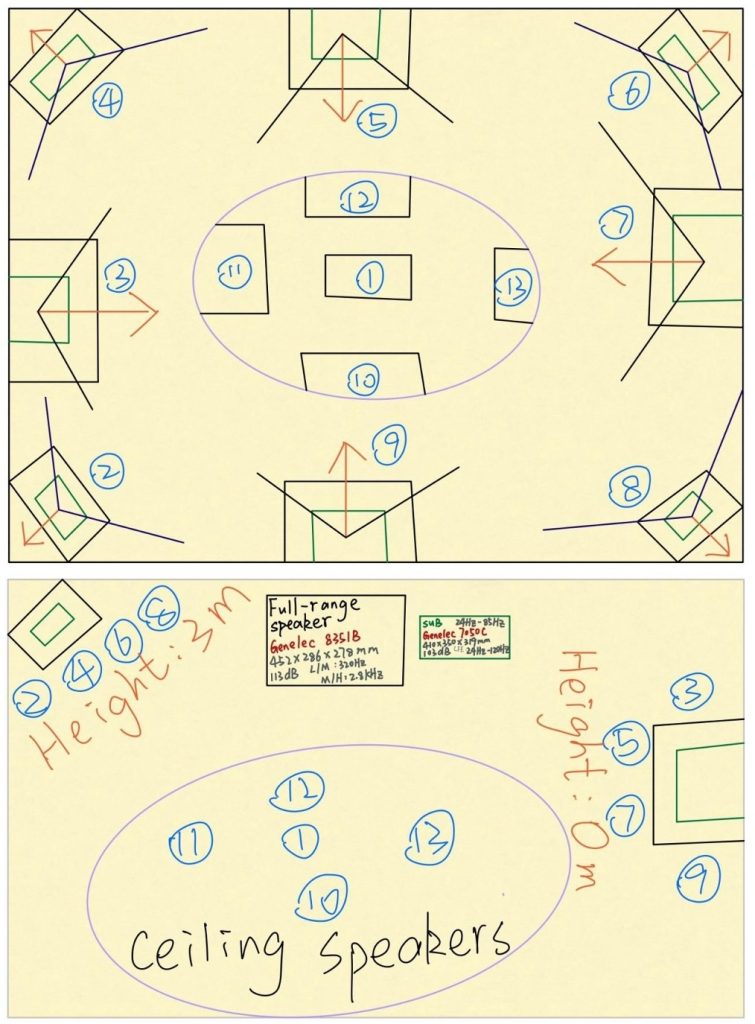
The work is composed for a thirteen-channel system distributed across the corners, walls, and ceiling of a rectangular room. In each corner, a subwoofer and a full-range loudspeaker share one channel and face the walls, allowing reflected sound to enter the space indirectly. Additional loudspeakers are positioned high along the walls and suspended overhead, creating multiple vertical and horizontal planes around the listener.
The spatial structure develops through four distinct stages. The opening emphasizes the corner-facing loudspeakers, using wall reflections to create an enveloping yet spatially ambiguous environment. Animal sounds then appear unpredictably from the wall-mounted and central overhead loudspeakers, producing shifting sensations of movement, direction, and proximity. As traffic and rain become concentrated above the listener, the active sound field grows quieter and more focused, creating a contemplative pause at a figurative crossroads. In the final section, the composition contracts to two diagonally opposed corner channels before resolving into a single direction. This gradual narrowing moves the listener from restlessness toward stillness.
Space functions as the work’s narrative structure. Each change in loudspeaker configuration alters the listener’s physical relationship with the sound: the listener is surrounded by reflection, approached from multiple directions, drawn upward, placed between opposing points, and finally guided toward a focused destination. The spatial movement gives audible form to an internal transition—from questioning whether a future in sound was possible to considering what kind of sound artist Mingjun wanted to become.
Road to Mingjun Y marks an early but defining moment in her practice, when sound became more than a professional possibility. It became a language through which she could shape stories, trust her instincts, and locate her own direction.